
Do Solar Panels Need Cleaning? The UK Solar Owner's Guide for 2026
Rain, dust, pollen and bird droppings all land on your solar array — but does it actually need cleaning? The better question is whether your system is performing as expected, and here's how to tell.

Updated September 2026 | Make Green Energy
Your solar panels are on the roof.
You can't see them properly from the ground. The monitoring app still says they're generating.
So everything must be fine… right?
Not necessarily.
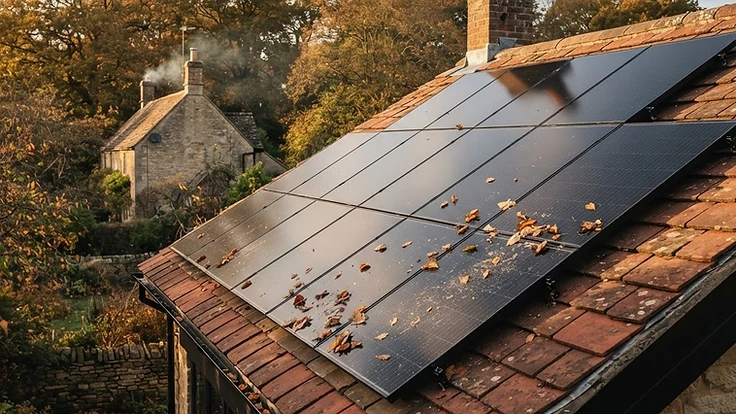
Across the UK, thousands of solar panels spend every day exposed to rain, dust, pollen, bird droppings, leaves and airborne pollution.
And one question is increasingly being searched by solar owners:
Do solar panels actually need cleaning?
The short answer is sometimes — but cleaning is only part of the story.
If you already have solar panels, understanding their condition and monitoring their performance could be more important than simply washing them.
Here's what UK solar owners should know.
Do Solar Panels Clean Themselves in the Rain?
To an extent.
Most rooftop solar panels are installed at an angle, allowing rainwater to remove some loose dust and debris naturally. That's one reason solar PV systems generally require relatively little routine maintenance.
But rain isn't a professional cleaning system. Think about your car: leave it outside through several rainstorms and it doesn't necessarily become spotless.
Some of these contaminants can remain even after heavy rain.
Industry guidance referenced by MCS notes that panels installed at steeper angles have a greater self-cleaning effect, while arrays installed at lower pitches may require a more structured cleaning programme.
Why Dirty Solar Panels Matter
A solar panel has one fundamental job: turn available sunlight into electricity.
Anything that prevents light from reaching parts of the photovoltaic cells has the potential to interfere with that process.
The important word here is potential. A slightly dusty panel doesn't automatically mean your solar system has suddenly become inefficient. But significant or uneven contamination deserves attention.
This is particularly important with something like bird droppings. Industry fire-safety guidance referenced by MCS identifies bird droppings as a particular concern because they can create partial shading across individual cells and contribute to hot spots.
That's very different from assuming "the rain will take care of everything."
The Bigger Question: Is Your Solar System Producing What It Should?
This is where solar ownership gets more interesting.
Instead of asking only "Are my panels dirty?" — ask "Is my solar system performing as expected?"
Imagine your solar installation generated considerably more electricity during similar conditions last year than it is producing now. There could be several explanations.
Cleaning the panels wouldn't necessarily solve those problems. That's why performance monitoring matters.
MCS-related guidance highlights online monitoring and error indication as valuable ways of understanding system operation and identifying potential problems earlier.
5 Signs Your Solar Panels May Need Attention
1. Your generation suddenly looks lower
Compare performance against previous periods with reasonably similar weather conditions. A noticeable unexplained reduction deserves investigation. Don't automatically assume the panels are faulty — but don't ignore it either.
2. You can visibly see contamination
If you can safely observe the array from ground level and notice obvious bird droppings, moss, leaves or substantial dirt, it may be time to investigate cleaning. Never put yourself at risk by climbing onto the roof simply to check.
3. Your panels sit at a relatively shallow angle
Panels installed at steeper angles generally benefit more from natural rainfall cleaning. MCS-related guidance specifically notes that lower-pitched installations may require scheduled cleaning. This can be particularly relevant for some:
- Commercial buildings
- Warehouses
- Flat-roof installations
- Outbuildings
- Agricultural buildings
4. Your property is surrounded by contamination sources
Location matters. A solar array near heavy traffic, construction activity, agricultural land, trees, large bird populations or industrial activity may experience different contamination from a relatively sheltered suburban roof. There isn't one cleaning schedule that applies to every solar installation.
5. Nobody has looked at the system for years
Solar panels are designed for long-term operation. That doesn't mean the entire system should simply be forgotten for decades. Your solar installation includes much more than panels — there can also be inverters, isolators, cables, connectors, mounting equipment and monitoring equipment.
MCS's solar PV handover checklist expects owners to receive information covering maintenance requirements, procedures for verifying correct operation, what to do if the system fails, and any applicable cleaning recommendations. If you still have your original installation documents, that's a good place to start.
How Often Should Solar Panels Be Cleaned?
There isn't a universal answer. That's important.
You may see companies recommending cleaning every six months. Others might say annually. Others may tell you solar panels never need cleaning.
The sensible answer is: it depends on the installation. Factors include:
- Panel angle — a steep residential roof may naturally shed contamination more effectively.
- Location — an array beside farmland may experience different contamination from one in a residential development.
- Trees — nearby vegetation can introduce leaves, pollen and other organic material.
- Bird activity — persistent bird droppings may require attention.
- System design — large commercial arrays can have very different maintenance requirements from a small domestic installation.
- Observed performance — your monitoring data may help identify whether further investigation is worthwhile.
Rather than cleaning purely because a calendar says so, the maintenance strategy should reflect the actual system.
Can I Clean Solar Panels Myself?
For easily accessible systems, owners may be tempted to do it themselves.
But rooftop solar creates two obvious hazards: height and electricity.
MCS-linked fire-safety guidance says solar panel cleaning should be performed by personnel who understand the risks involved and have appropriate risk-control procedures.
So don't climb onto a roof just because you spotted a dirty panel. And don't assume that somebody experienced in ordinary window cleaning automatically understands the electrical risks associated with solar PV.
Should You Pressure-Wash Solar Panels?
Don't assume more pressure means better cleaning.
Solar panels aren't a driveway. Aggressive cleaning techniques could potentially damage components or seals depending on the system and manufacturer requirements. Before cleaning, the manufacturer's maintenance instructions should be checked.
Avoid:
Walking on panels. Abrasive cleaning materials. Harsh chemicals. Unapproved high-pressure cleaning.
And most importantly: don't risk a fall from the roof to save the cost of professional help.
Commercial Solar Owners Should Pay Particular Attention
Now imagine the same problem on a warehouse containing hundreds of panels.
A commercial solar array represents a much larger energy-producing asset. For businesses, reduced generation isn't simply a technical issue. It can become a financial one.
If a warehouse expects its solar array to offset a meaningful proportion of daytime electricity consumption, poor system performance can mean more electricity needs to be purchased from the grid.
That's why commercial solar maintenance shouldn't simply mean "call someone when something breaks." It should involve understanding:
- How much should the system be generating?
- How much is it actually generating?
- Are there recurring inverter errors?
- Are sections of the array underperforming?
- Is contamination developing?
- Has new shading appeared?
- Does anything require inspection?
MCS-linked guidance notes that larger PV systems are more likely to have formal maintenance arrangements and highlights the value of operational monitoring.
Your Solar Panels Could Be Fine — But What About the Rest of the System?
This is where many owners focus on the wrong thing.
You can have perfectly clean solar panels and still have a system that isn't operating as intended. The array is only one part of the installation. Consider the:
- Inverter — converts the electricity generated by your panels into electricity suitable for use within the property.
- Connections and cabling — critical parts of the electrical system.
- Mounting equipment — your panels must remain securely attached while protecting the integrity of the roof.
- Monitoring system — without accurate monitoring, identifying underperformance becomes harder.
- Battery — if your installation includes battery storage, its operation and settings also affect how your generated electricity is used.
This is why Make Green Energy believes solar owners should think in terms of system performance, not simply panel cleanliness.
Bought a Property With Solar Panels Already Installed?
This situation deserves special attention.
You buy a house. There are panels on the roof. Great.
But then come the questions:
Who installed them? How old are they? What panels were used? Is there an MCS certificate? What inverter is installed? Are warranties still valid? How much electricity should the system generate? Is the system actually performing correctly? Could battery storage improve how you use the generated electricity?
These are much better questions than simply assuming that having panels means everything is working optimally.
Have an Older Solar System? Don't Automatically Replace It
Solar technology has moved quickly. Modern panels, inverters, batteries and monitoring systems can offer capabilities that weren't common when many older UK systems were installed.
But that doesn't mean an older installation automatically needs replacing. Depending on its condition, there may be opportunities to:
- Continue using the existing system
- Investigate underperformance
- Upgrade monitoring
- Add compatible battery storage
- Expand generation where appropriate
- Replace particular components
- Redesign parts of the installation
The correct approach depends on the existing equipment and property.
The £0 Question Every Solar Owner Should Ask
Not: "When should I clean my solar panels?"
But: "Is my solar investment still performing the way it should?"
Because the objective wasn't to put panels on your roof. The objective was to generate electricity.
That distinction matters.
Already Have Solar Panels? Make Green Energy Can Help
If you already have solar but aren't sure how well the system is performing, don't immediately assume you need a new installation. Start by understanding what you already have.
Make Green Energy can discuss your existing solar setup and determine what the appropriate next step may be. That could include exploring existing system performance, solar upgrades, battery storage, additional solar capacity, inverter upgrades, EV charging integration, commercial solar expansion — or a new solar PV installation where appropriate.
Your roof may already contain an energy asset. The question is whether you're getting the most from it.
Already have solar — but not sure what it's doing?
Make Green Energy helps homeowners understand existing solar systems, explore battery-storage options and shape their household's electricity use around how the system actually performs.
Understand Your Solar SystemRelated Insights
This article is part of our series helping UK households and businesses get more from solar:
- Moving Into a Home With Solar Panels? Here's What You Need to Know — understanding an inherited system
- Solar Panels UK in 2026: Cost, Batteries, Cleaning & What Homeowners Should Know Before Installing — the complete 2026 buyer's guide
- Solar Is Getting Cheaper. So Why Is the Grid Becoming the Bigger Challenge? — why storage and timing matter as much as cost
Explore our latest insights, or read more about domestic solar, battery storage and commercial solar.
About Make Green Energy
Make Green Energy helps UK homeowners and businesses understand and access practical renewable-energy solutions, including solar PV, battery storage and energy-saving technologies. Our engineers design, install and support systems built around your property and long-term energy goals.
Frequently Asked Questions
Ready to explore solar for your property?
Whether you're considering solar panels, battery storage or a more complete renewable-energy solution, Make Green Energy can help you understand your options.
Related articles

Solar Panels UK in 2026: Cost, Batteries, Cleaning & What Homeowners Should Know Before Installing
How much do solar panels cost in the UK in 2026? Do you need a battery — and do panels work when it's cloudy? An installer's guide to costs, payback, cleaning and the questions to ask before you buy.

How Much Do Solar Panels Cost in the UK in 2026? The Real Cost vs Savings
An average UK solar PV system costs around £7,600 — but the cheapest quote isn't the cheapest system to own. Real costs, savings, payback periods and how to compare quotes properly.

Solar Panel Battery Storage UK: Is a Solar Battery Worth It in 2026?
Is a solar battery worth it in the UK? A battery's value depends on when you use electricity. Here's how sizing, grid charging, EVs and export tariffs decide the answer for your property.