
Moving Into a Home With Solar Panels? Here's What You Need to Know
Moving into a home with solar panels already on the roof should feel like a bonus — but many new occupants are left with almost no information about the system. Here's how to establish what you own, what it generates and how to get the most from it.

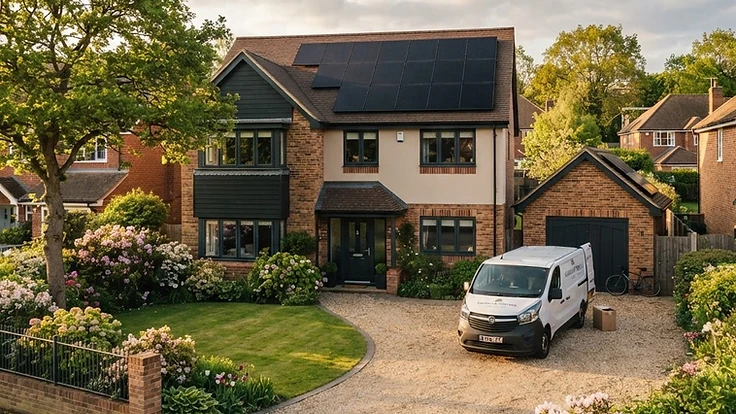
Moving into a property that already has solar panels should feel like a bonus.
But for many people, the first reaction is actually different. Something closer to: "Great… but what do I do with them?"
A recent discussion in the UK solar community captured this perfectly. Someone was moving into a council property with an existing south-west-facing solar array, but had received virtually no information about the system. They didn't know how much electricity it generated, whether it required maintenance, where the equipment was located, or even exactly how the arrangement worked.
That raises a much bigger issue. Installing solar is only half the job. Understanding how to use it is what turns panels on a roof into an energy asset.
So if you've moved into a home with solar panels already installed, here are the questions worth answering.
1. First: Find Out Who Actually Owns the Solar Panels
Don't assume that solar panels attached to the property automatically belong to you.
Older UK installations can have different ownership arrangements. Some historical installations involved third-party or "rent-a-roof" schemes, where a company owned the panels in exchange for the roof space — and those arrangements can survive a change of occupier.
If you're purchasing a property, your solicitor or conveyancer should establish the position. If you're renting — from a council, housing association or private landlord — ask the property owner or managing organisation for information about the installation.
You want to establish:
- Who owns the system?
- Who is responsible for repairs?
- Who receives any export or historic Feed-in Tariff payments?
- Can you access the monitoring system?
- Are you permitted to modify the system or add battery storage?
That last question is particularly important for tenants. Don't assume you can alter an existing solar installation simply because you occupy the property.
2. Find the Inverter — One of the Most Important Parts of the System
The panels are the most visible component, but another important piece of equipment is normally somewhere inside the property: the inverter.
Solar panels generate direct current (DC) electricity. The inverter converts that electricity into alternating current (AC) that the home's electrical system can use. If the inverter isn't working, the panels on the roof effectively aren't contributing — which is why knowing where it is, and what its display or status lights are telling you, matters so much.
Depending on the installation, equipment might be found in any of the places above. There may also be isolators, meters, monitoring equipment and possibly battery-storage equipment alongside it.
The discussion that prompted this article is a useful example of why this matters: the new occupant could see the panels and a solar-related fuse box, but hadn't yet identified the rest of the installation.
Don't start opening electrical equipment to investigate it. If you're unsure what something is, have the property owner or a competent solar or electrical professional identify it for you.
3. Find the Solar Paperwork
A properly documented solar PV installation should come with considerably more information than "there are some panels on the roof".
MCS's handover checklist for Solar PV expects installers to leave the customer with items such as the MCS certificate, key component information, estimated system performance, inverter documentation, the electrical schematic, commissioning information, procedures for checking correct operation, and maintenance recommendations.
So if you've inherited an existing system, try to locate:
- The MCS certificate — your proof of certified installation
- The system specification — panels, inverter and, if fitted, battery
- Panel and inverter details — make, model and serial numbers
- Warranties — equipment, installation and, if relevant, roof work
- The installation date
- A performance estimate — expected annual generation
- Maintenance information — cleaning, inspection and shutdown procedures
- Monitoring details — app, portal or display access
If those documents aren't available, don't panic. It doesn't automatically mean there's something wrong with the installation. But establishing exactly what equipment you have is an excellent starting point.
4. How Much Electricity Should Your Solar Panels Generate?
This is usually the question people care about most. Unfortunately, counting the panels alone isn't enough.
A 3 kWp system and a 6 kWp system have very different potential, and orientation, pitch, shading from trees, neighbouring buildings and chimneys, plus the panels' and inverter's condition, all shape the result.
A south-west-facing array can absolutely generate useful electricity. But you shouldn't estimate annual performance solely from orientation — and you shouldn't judge the entire system from one December afternoon. Solar generation varies considerably throughout the year; a system that produces strongly in June may look almost idle in midwinter. That's normal, not a fault.
5. The Most Important Change May Be How You Use Electricity
This is where having solar becomes interesting.
Imagine your panels are generating electricity at midday. Your house only requires part of it, and the remaining electricity can potentially be exported. But later that evening, solar generation falls — and you start importing electricity from the grid again.
So a household with solar should start thinking not only "How much electricity do I use?" but also "When do I use it?"
This is sometimes called increasing self-consumption.
If your solar system is producing strongly during the day, shifting flexible electricity use into those hours may allow you to consume more of the electricity you're generating yourself. Depending on your circumstances, that could mean running appliances such as the dishwasher or washing machine during suitable daylight-generation periods rather than automatically waiting until the evening.
One participant in the discussion that prompted this article made essentially this point — suggesting moving flexible consumption into sunnier periods.
There is an important caveat: don't override a cheaper time-of-use tariff simply because the sun is shining. Compare the value of self-consuming solar against the import and export tariffs you're actually on.
6. What Happens to Solar Electricity You Don't Use?
For eligible installations in Great Britain, surplus renewable electricity can potentially be sold back to the grid through the Smart Export Guarantee (SEG).
Ofgem explains that SEG suppliers pay eligible small-scale generators for electricity exported to the grid, that individual suppliers determine their own tariff rates and contract terms, and that eligible generators can shop around rather than necessarily using their existing import supplier.
For a qualifying SEG arrangement, the UK government's guidance says you'll generally need appropriate metering capable of providing half-hourly export readings, and evidence that the installation meets the relevant certification requirements.
However, an older installation may operate under different arrangements, including the historic Feed-in Tariff (FIT) scheme. That's another reason to establish the installation date, ownership and paperwork before making assumptions about what happens to exported electricity.
7. Do Existing Solar Panels Need Maintenance?
Solar PV systems generally don't require constant intervention from the homeowner. But "low maintenance" shouldn't be confused with "ignore it forever." The more useful habit is monitoring.
If a system normally generates consistently and suddenly produces dramatically less — or stops generating altogether — that deserves investigation. Periodically pay attention to:
- Generation performance
- Inverter status and error messages
- Monitoring alerts
- Visible panel damage
- Unexpected shading
- Changes following roof or building work
MCS's handover guidance specifically expects system owners to receive information on verifying correct operation, what to do in the event of a system failure, shutdown and start-up procedures, and maintenance and cleaning recommendations.
If you're moving into a property with an older installation and no documentation, a professional inspection can help establish what you actually have and whether it's operating correctly.
8. Should You Add a Battery?
Maybe — but don't buy one just because you have solar panels.
A battery can store electricity for later use:
That sounds automatically better, but the economics depend on your individual situation. You need to consider things like:
- How much electricity your panels generate
- How much you consume directly
- When you consume electricity
- How much surplus you export
- Your import tariff
- Your export tariff
- Battery capacity
- Battery efficiency
- Battery cost
- Battery warranty and degradation
- Compatibility with the existing solar system
The government also notes that storage devices capable of importing and exporting electricity can potentially interact with SEG arrangements, although the relevant supplier's requirements need to be checked.
So the right question isn't "Do solar panels need a battery?" It's: "Would a battery improve the economics and energy-use profile of my system?" That's a much better question.
9. Seven Things We'd Check After Moving Into a Solar Home
If you've just received the keys to a property with panels on the roof, start here:
- Who owns the solar installation?
- When was it installed?
- What is the system's rated capacity?
- Where is the inverter, and what model is it?
- Is there monitoring available?
- Who receives any export or FIT payments?
- How much electricity is the system actually generating?
Once those questions are answered, you can start making informed decisions about consumption patterns, tariffs, maintenance and potentially battery storage.
The Panels Are Already There. Now Learn to Use Them
The most interesting part of that discussion wasn't the equipment. It was the uncertainty.
Someone had moved into a property containing an electricity-generating system — but had almost no information explaining what it was doing.
And that's something the solar industry should take seriously. Solar shouldn't feel mysterious once the installer leaves. A homeowner should understand what their system generates, how to monitor it, what happens to surplus electricity, how to spot a problem, and how their daily electricity habits affect the value they receive from solar.
Because putting panels on a roof is only the beginning. Understanding your energy is what gives you control over it.
Already have solar — but not sure what it's doing?
Make Green Energy helps homeowners understand existing solar systems, explore battery-storage options and shape their household's electricity use around how the system actually performs.
Understand Your Solar SystemRelated Insights
This article is part of our series helping UK households and businesses get more from solar:
- Solar Is Getting Cheaper. So Why Is the Grid Becoming the Bigger Challenge? — why generation, storage and timing now matter as much as cost
- How to Read Your Solar Monitoring Data (coming soon)
- Batteries and Time-of-Use Tariffs: What Homeowners Should Understand (coming soon)
Explore our latest insights, or read more about domestic solar and battery storage.
About Make Green Energy
Make Green Energy helps UK homeowners and businesses understand and access practical renewable-energy solutions, including solar PV, battery storage and energy-saving technologies. Our engineers design, install and support systems built around your property and long-term energy goals.
References & Further Reading
Frequently Asked Questions
Ready to explore solar for your property?
Whether you're considering solar panels, battery storage or a more complete renewable-energy solution, Make Green Energy can help you understand your options.
Related articles

Solar Panels UK in 2026: Cost, Batteries, Cleaning & What Homeowners Should Know Before Installing
How much do solar panels cost in the UK in 2026? Do you need a battery — and do panels work when it's cloudy? An installer's guide to costs, payback, cleaning and the questions to ask before you buy.

Do Solar Panels Need Cleaning? The UK Solar Owner's Guide for 2026
Rain, dust, pollen and bird droppings all land on your solar array — but does it actually need cleaning? The better question is whether your system is performing as expected, and here's how to tell.

How Much Do Solar Panels Cost in the UK in 2026? The Real Cost vs Savings
An average UK solar PV system costs around £7,600 — but the cheapest quote isn't the cheapest system to own. Real costs, savings, payback periods and how to compare quotes properly.